FBA Removal Fees in Europe 2026: Return or Dispose?
"Just dispose of it. It's cheaper than sending it back."
You have probably read this in a seller forum, often from someone trying to help. Some posts go further: return and disposal cost the same, so why bother with the boxes?
In Amazon Europe, this is false.
That advice was written for another marketplace. Here, the official fee table says exactly the opposite.
Disposing of a unit costs about 50% more than getting it back. On every weight band.
 Disposal costs about 50% more than a return in Amazon Europe.
And the fee is the small part of the story.
Quick Answer: In Amazon Europe, a return-to-seller order is cheaper than a disposal order on every weight band.
A standard unit of 201–500 g costs €0.79 to return and €1.19 to dispose of, about 50% more. Even a cross-border return (€1.04) beats disposal.
The bigger difference comes after the fee. Returned units can go back into Amazon or onto a secondary market. Disposed units are value lost forever.
🗣️ Why Do Sellers Think Disposal Is Cheaper?
Because the advice comes from US seller forums, and it travelled to Europe without anyone checking the European fee table.
"The best and cheapest option is to have it disposed" is a typical answer on the US boards. Some European logistics blogs repeat the same idea, and sellers pass it on to each other as common sense.
In Seller Central, the choice looks neutral. When you create a removal order there are 2 options:
- Return: the units come back to your address.
- Dispose: Amazon donates or recycles what it can. You never see the units again.
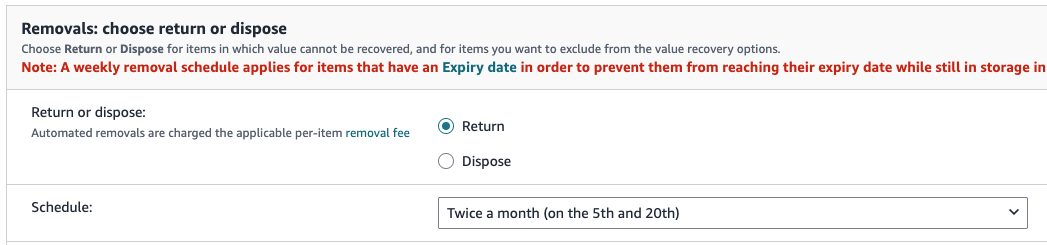 Seller Central, automated removals: Return or Dispose. Same form, two options.
But what is the difference in terms of money?
💶 How Much Are FBA Removal Fees in Europe in 2026?
A local return costs €0.50 to €2.32 per standard unit. Disposal costs €0.74 to €3.73. These are Amazon's 2026 EU rates for standard-size units.
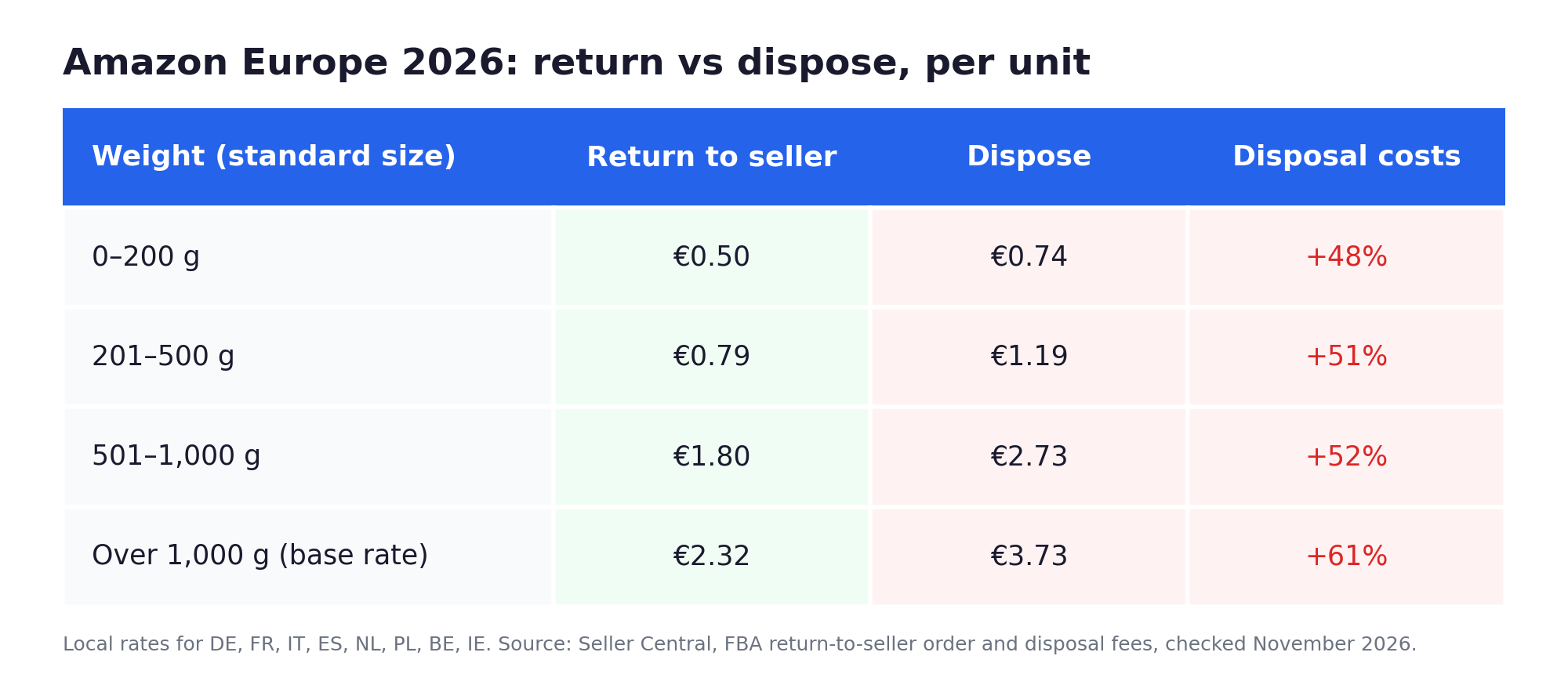
In text, per standard unit:
- 0–200 g: €0.50 to return, €0.74 to dispose (+48%)
- 201–500 g: €0.79 to return, €1.19 to dispose (+51%)
- 501–1,000 g: €1.80 to return, €2.73 to dispose (+52%)
- Over 1,000 g: €2.32 to return, €3.73 to dispose (+61%, base rate)
What if your warehouse is in a different country from the stock?
With Pan-European FBA, you pay the local rate when your return address is in a main marketplace (DE, FR, IT, ES, NL, PL, SE, CZ or the UK).
Without it, a cross-border return within the EU still costs less than disposal: €1.04 against €1.19 for a 201–500 g unit.
On fees alone, returning wins in every band. But fees are only the first line of the calculation, and the smallest one.
📊 What Is the Return-or-Dispose Choice Worth in a Year?
For a seller doing €1.5M a year, returning unsellable customer returns instead of disposing of them is worth about €7,700 a year.
Here is the profile behind that number:
- Revenue: €1.5M a year
- Average price: €25, so 60,000 units sold
- Landed cost: €6 per unit
- Unsellable returns: 3% of units sold, so 1,800 units a year
- Size: standard, 201–500 g
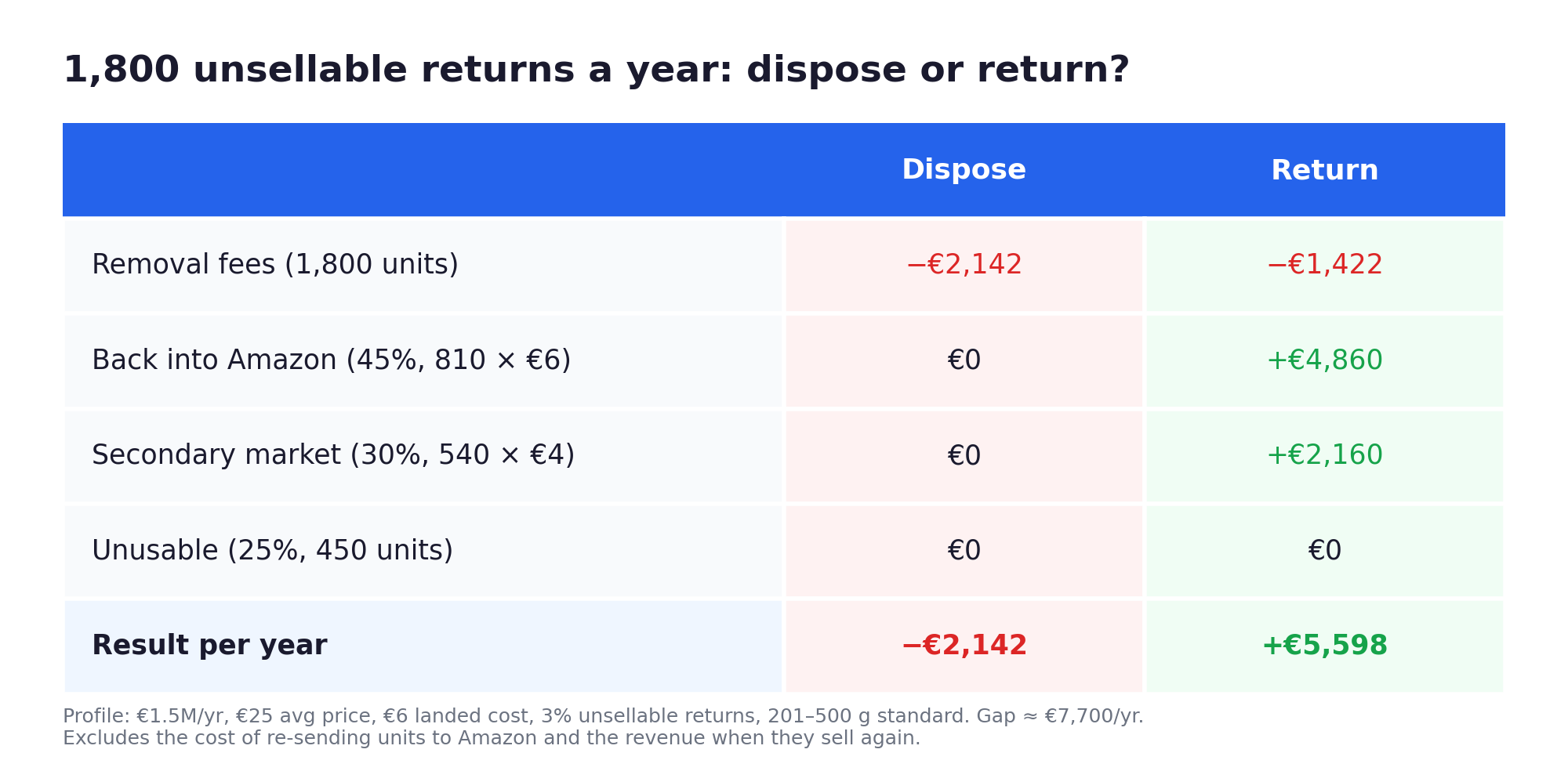 Dispose: €2,142 in fees, nothing comes back (−€2,142). Return: €1,422 in fees, €7,020 comes back (+€5,598).
Where does the €7,020 come from? Once the units are in your hands, you decide what each one is worth.
An unsellable label is often wrong. In a real account I analysed, 45% of unsellable returns could be sold again. That share is your recovery rate, one of the return metrics worth tracking.
So the 1,800 units split like this:
- 45% go back into Amazon: 810 units × €6 landed cost = €4,860 of stock you do not have to buy again.
- 30% go to a secondary market: 540 units × €4 discounted landed cost = €2,160.
- 25% are truly unusable: counted at zero.
About €7,700 a year, for the same 1,800 units.
The fee difference is €720. The rest is stock you keep.
Note: this calculation leaves out the cost of sending the 810 units back into Amazon, and the revenue when they sell again.
"Rule No. 1: Never lose money. Rule No. 2: Never forget rule No. 1." – Warren Buffett
Why does the stock weigh so much more than the fee?
♻️ Why Is Returned Stock Worth More Than the Fee Saved?
Because those units are capital you have already spent. Replacing them costs more and takes longer.
Supplier prices rise, and inflation adds its share every year. A new order also needs production time, shipping time and another inbound shipment to Amazon before it sells.
A unit you already own skips all of that. It can go back on sale as soon as it is checked, repackaged if needed, and sent back in.
There is a simpler reason too. Most of these products are good, and some were never even used. It is a pity to throw them away.
📦 What Happens When the Boxes Come Back?
Returning only pays off if someone opens the boxes. Every unit inside has one of three outcomes:
- Back on sale: the unit is fine and goes back into Amazon.
- Secondary market: the unit is used or damaged, but still worth something.
- Claim: the shipment itself went wrong, and Amazon owes you a reimbursement.
Removal shipments go wrong more often than sellers think, because nobody checks what comes back. Here is what we see in our clients' accounts:
- Never delivered: the shipment gets lost on its way back to you.
- Incomplete shipment: fewer units in the box than in the order.
- Wrong item (switcheroo): products inside that are not yours.
- Incomplete product: the customer kept part of the product.
Each of these can be reimbursed. But only if someone looks inside the box and records what is there. The full list of claim types is in Every FBA Reimbursement You Can Claim in 2026.
A disposed unit takes its evidence with it.
Have you ever opened a removal box and found something that was not yours?
Get ready before the return wave
Now is the right moment. The holiday return wave has not started yet.
Purchases from November and December can be returned until January 31. The unsellable ones become your next removal orders. I described that wave in FBA Profits at Risk: The Amazon Holiday Return Trap.
Build the process now, before the boxes start arriving. If it starts when they are already piling up, the money is already leaking.
You do not need a big team for this. One person with the right tool is enough: a warehouse colleague, or you, if you run the business on your own.
With the Eagle Eye Return Scanner in hand, you scan each unit and the app guides you through the rest. The Eagle Eye team also sets up your removal settings with you as part of the initial setup.
Once it runs, this part of FBA works for you in three ways:
- Reimbursements on the removal shipments that go wrong
- Lower fees than disposal, on every unit
- More money from the units that go back on sale
Want to see what this is worth in your own account? Upload your Seller Central reports to our free Returns & Removals audit. No email needed. You'll see the reimbursement opportunities hiding in your removals.