3 FBA Return Recovery Metrics Most Sellers Ignore
Two FBA sellers. Same products. Same return rate.
One recovers 40% of returned units. The other recovers 70%.
That gap is worth over €4,000 a month in capital. Not from reducing returns. From what they do with the units that already came back.
The difference is 3 metrics. Most sellers have never heard of them.
📦 What Actually Happens to a Returned Unit
Let's start with the physical flow.
When a customer returns a product to FBA, Amazon evaluates it at the warehouse. The unit gets assigned to one of two categories:
- Sellable: Amazon considers it in good condition to go back into your active inventory, ready to fulfill a new order. No action required on your end. The capital was briefly out of circulation, but it is back.
- Unsellable: Amazon deems it unfit for resale. It sits in a separate inventory bucket, accumulating storage fees, until you tell Amazon what to do with it.
The sellable units are handled automatically. The unsellable ones feel like a lost cause, and many sellers have them disposed by Amazon without a second thought.

But "unsellable" is not final. It means Amazon could not confirm the unit was perfect. It does not mean you cannot.
The three metrics below give you a framework to measure each step of this process.
📊 Metric 1: FBA Return Recovery Rate
This is the baseline. It tells you what fraction of returned units Amazon automatically routes back into your active inventory without any action on your end.
Formula:
FBA Return Recovery Rate = Sellable Returns / Total Returns

What it tells you: For every 100 units that come back through customer returns, how many does Amazon evaluate as sellable and put straight back into your inventory?
Example: 100 returns in a month. Amazon marks 40 as sellable. Your FBA Return Recovery Rate is 40%.
This number is partly within your control. Product category, fragility, and packaging design all affect it. A product that arrives in a clean, resealable box has a structurally higher FBA Recovery Rate than one with torn multi-piece packaging. If your packaging is easy to open without damage and easy to reseal, more units survive a customer return intact. Call it "designed to return."

This metric establishes your floor. It tells you what you get without doing anything. The next two metrics tell you what is possible by taking action.
🔍 Metric 2: Seller Return Recovery Rate
This is where the opportunity lives, and where most sellers leave the most money behind.
When Amazon marks units as unsellable, do not opt for disposal.
Instead, set up a removal order and bring them back to your warehouse.
Here is what most sellers find when they actually look: a meaningful share (40% to 60%) of those "unsellable" units are not damaged. Amazon was conservative, or the outer packaging was dented, or the unit simply needs a new carton to be fully resellable again. A replacement box costs a few cents. The product inside is worth its full value. And you can resend it to FBA.
Formula:
Seller Return Recovery Rate = Seller Recovered Units / Total Unsellable Returns

What it tells you: Of the units Amazon wrote off as unsellable, what percentage did you actually recover through your own warehouse inspection?
Example: 60 unsellable returns arrive at your warehouse. Your team inspects them. 30 are in perfectly resellable condition, some needing a new carton. Your Seller Return Recovery Rate is 50%.
This metric is entirely within your control. It depends on whether you have a process at all. Without a removal order workflow and an inspection checklist, this number defaults to 0% by definition.

If you take no action, you are letting Amazon's judgment be the final word on capital that belongs to you.
The sellers who score well on this metric share a few habits: they activate removal orders for unsellable returns rather than opting for disposal, they inspect incoming units against a simple condition checklist, they keep spare packaging on hand, and they re-FBA recovered units quickly. None of this is operationally complex. It just has to be a deliberate part of the process.
🏆 Metric 3: Total Return Recovery Rate
This is the number that matters. It combines Amazon Recovery with the Seller Recovery to give you the complete picture of how much capital you are saving from returns.
Formula:
Total Return Recovery Rate = (Sellable Returns + Seller Recovered Units) / Total Returns

What it tells you: Of every 100 units that come back through customer returns, how many are ultimately recovered and returned to sellable inventory between Amazon's system and your team?
The full example, using the numbers from above:
- 100 total returns
- 40 evaluated as sellable by Amazon, back in active inventory
- 60 evaluated as unsellable, sent to your warehouse
- 30 of those 60 recovered by your team after inspection
- Total Recovery Rate = (40 + 30) / 100 = 70%
The difference between a 40% recovery rate and a 70% recovery rate is 30 units per 100 returns.

On a product worth €30, that gap represents €900 in recovered capital for every 100 returns. For a seller receiving 500 returns per month at that price point, the difference between doing nothing and running a basic inspection workflow is over €4,000 per month in recovered inventory value.
That number does not appear anywhere in your return rate report. It only appears when you track it.
💡 From Metrics to Action
Return rate measures risk. Return recovery rate measures your response to this risk.
Sellers who obsess over return rate try to stop returns from happening. But this is a battle they cannot win. Returns will always be there.
Sellers who optimize for return recovery rate treat every unit that comes back as an asset to recover, not a write-off. They close the capital cycle.
The practical starting point is simple: activate removal orders for unsellable returns instead of opting for disposal. Disposal is permanent. A removal order gives you the chance to evaluate the unit yourself. Once the units arrive, build a basic inspection checklist for your warehouse team. What condition qualifies as resellable? What requires repackaging? What is genuinely unsalvageable?
Track the three numbers above monthly. FBA Recovery Rate, Seller Recovery Rate, Total Recovery Rate. You will find recoverable units in there. The question is only how many, and what they are worth.
"Price is what you pay. Value is what you get." – Warren Buffett
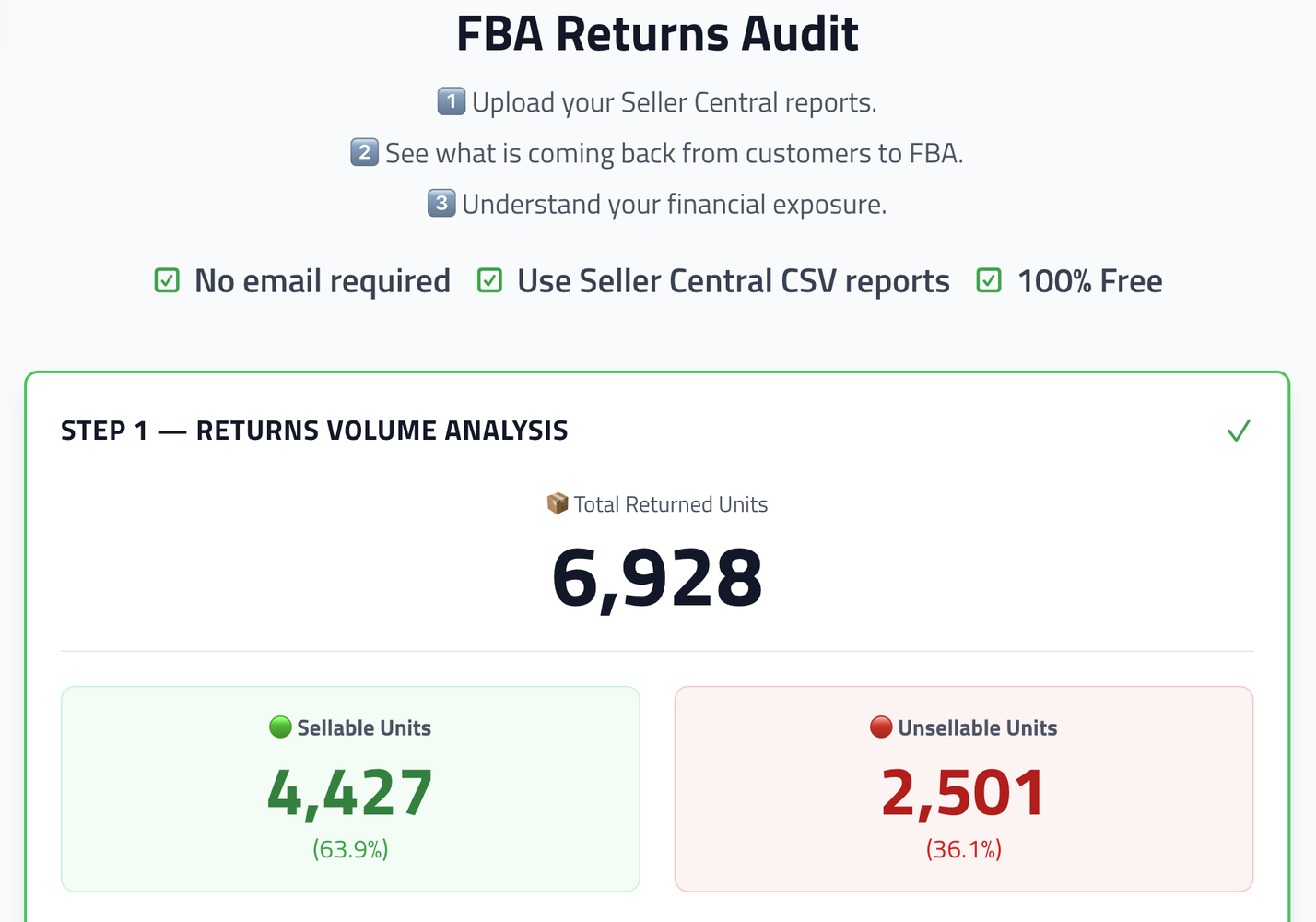
This seller's FBA Return Recovery Rate is 63.9%. Out of 6,928 returned units, Amazon put 4,427 straight back into active inventory without any action on their end.
Do you know your number? Can you beat 63.9%? Or do you score lower?
Upload your Seller Central report and find out in 2 minutes. No email required.