How Agencies Can Outsource FBA Reimbursements Safely
Ask an Amazon agency who handles FBA reimbursements for its clients, and you will get one of two answers.
- "We do, it's part of our offer."
- "We don't, that's not our job, but if a client asks, we try."
I have heard both many times this year, talking with agencies and account managers across Italy.
Both answers leave the client exposed. And both cost the agency more hours than it would like to admit.
Quick Answer: Agencies can outsource FBA reimbursements safely by choosing a partner whose work they can see. In practice, that means:
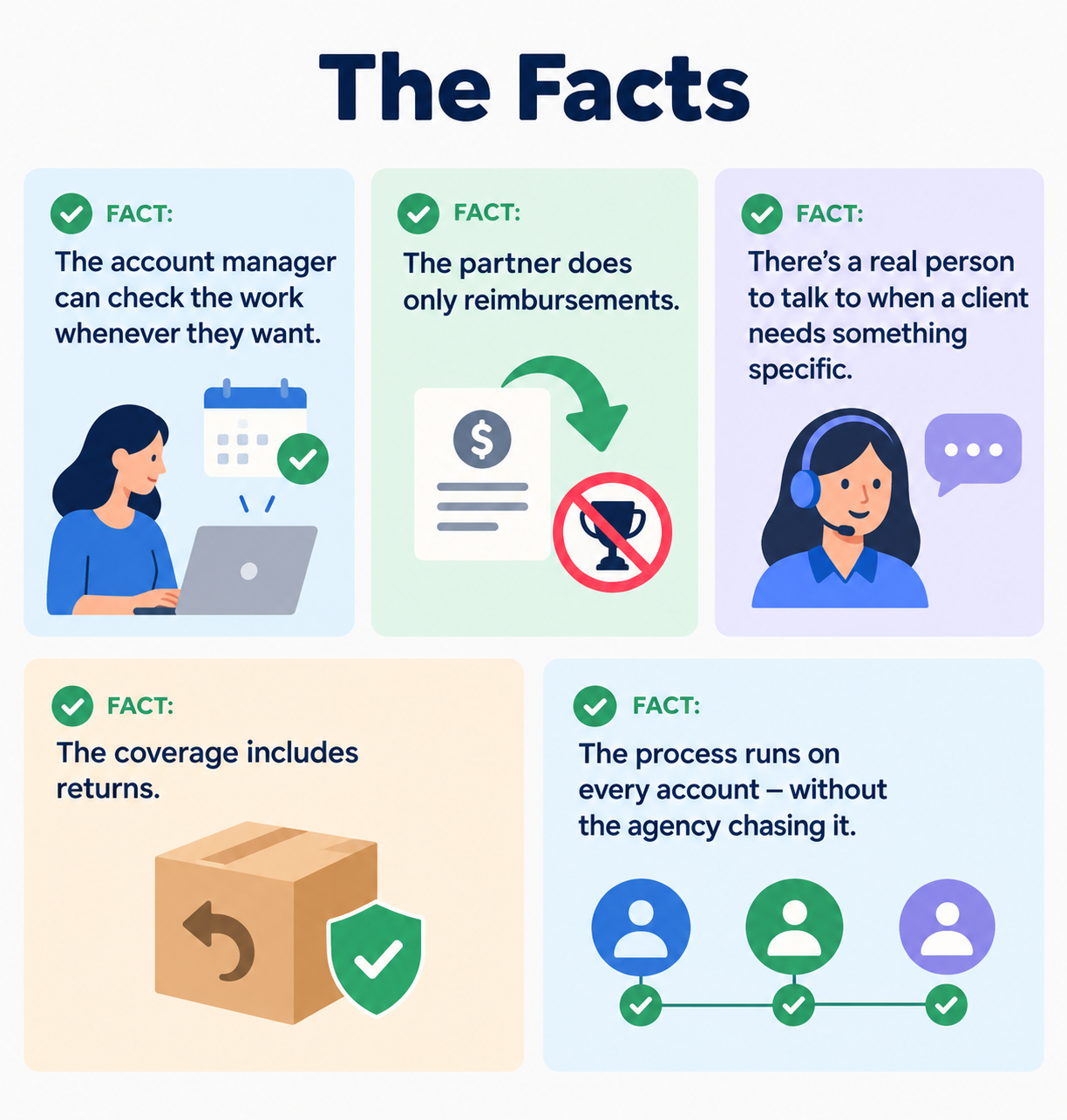
- a shared channel the account manager can check whenever they want
- a partner with no interest beyond reimbursements
- coverage wide enough to include returns
- a process that runs on every FBA account without the agency chasing it
Account managers get their hours back. Sellers stay covered, which is a must in Q4.
🕳️ Who Handles FBA Reimbursements?
Reimbursements sit in a grey zone between the account manager and the seller. They are:
- too technical for the seller
- too time-consuming for the account manager
Agencies look at this grey zone from two opposite sides.

The agency that promised it. Reimbursements were written into the offer as an included service. Then reality arrived.
One partner told me:
"We advertised it as an included part of our offering, but we realized we are wasting too much time without covering it to the full extent."
The agency that ruled it out. Reimbursements were never part of the deal. Sellers still ask.
Another partner put it this way:
"We made clear we do not offer this service, but from time to time the customer asks us to try to solve an FBA issue... just once please."
In both cases, the agency pays with its own time. The seller pays with money that never comes back.
Either way, a part of the client's FBA business stays in the dark.
Does one of these sound like your agency? If so, the obvious question is why the work doesn't simply go to a specialist.
🤝 Why Don't Account Managers Just Hand FBA Claims Off?
Because handing off means losing sight of it.
An account manager answers to the seller for the whole account. Passing a piece of it to a third party they can't see feels like a risk to the relationship.
This is a problem of trust and control.
One account manager summed it up better than I could:
"Other services do not provide a trusted communication channel, so I cannot recommend them to my seller customers."
That sentence explains a lot. An account manager's reputation is on the line with every partner they bring into an account.
Another partner tried one of the big reimbursement services for one of his clients. He needed a few specific adjustments to the standard process for that seller.
He could not find anyone to talk to about them, or anyone to take ownership. No real person on the other side, listening to his needs or to the seller's.
So the account manager keeps the work and does it halfway. The seller stays half covered.
The fix is a partner whose work you can check at any time, without having to watch it.
"Trust, but verify." – Ronald Reagan, quoting a Russian proverb
👀 What Does a Safe Hand-Off Look Like?
A safe hand-off rests on three things:
- you can check the work whenever you want
- the partner has no interest in your client beyond reimbursements
- the coverage is wide enough that nothing drifts back to your desk
With those in place, delegating stops feeling like losing control.
1. Transparent, whenever you want to look
At Eagle Eye, each seller has a WhatsApp group with our team. The account manager can join it.
Every question we ask, every document we request and every update we send lives in that thread. You don't have to follow it, we run the work.
Whenever you want to check what we are doing, it is all there.
How involved the agency gets depends on its agreement with the seller:
- some sellers send us documents directly
- some agencies prefer to handle that themselves
- others take turns
All of these work for us.
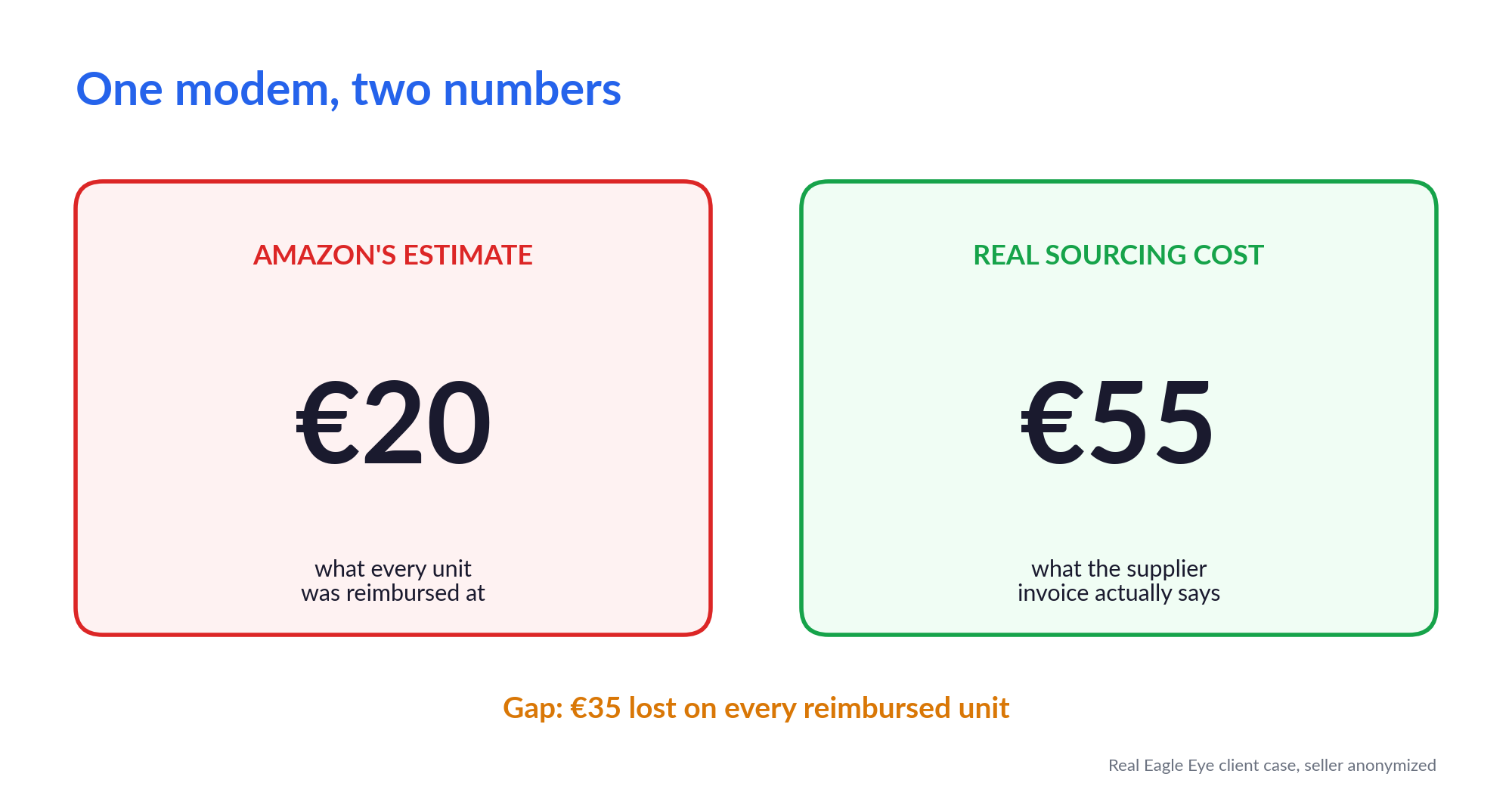
An example with one client: we collected the supplier invoices once. We have reused them since for sourcing cost re-evaluations, invoice-based claims and warehouse issues.
(If you don't know about sourcing costs and re-evaluation, I walked through a real one in Two Rejections Later, One Sourcing Cost Update Was Worth €805.)
2. One job, no competing interests
Eagle Eye does one thing: FBA reimbursements. We don't run PPC, build catalogues or manage accounts, so we have no reason to compete for your client.
Our only job is getting back what Amazon owes them.
That focus also makes us easy to reach. We are a message away in the same WhatsApp group.
Account managers use it for other FBA questions too, whenever something in an account looks off.
3. Coverage that reaches returns
A partner that covers only a few claim types leaves the rest on your desk.
We recover across the full range of FBA reimbursements, from inbound shipments to units lost or damaged in Amazon's warehouses. I listed every type in Every FBA Reimbursement You Can Claim in 2026.
Returns deserve their own mention. Items come back damaged, incomplete or different from what was sold.
It is the pain point sellers complain about most, and the complaint often lands on the account manager's desk.
With our Return Scanner app, the seller's warehouse team photographs what comes back. Those cases turn into claims with evidence behind them.
Before handing reimbursements to any partner, check five things:
- Visibility: can the account manager check the work whenever they want, without following it day to day?
- Focus: does the partner do only reimbursements, with no interest in competing for your client?
- Availability: is there someone to talk to when one client needs something specific?
- Returns: does the coverage include returns, the claims sellers complain about most?
- Repeatability: does the process run on every account without the agency chasing it?
If the answer to any of these is no, the work will drift back to the account manager's desk.
📐 One Partner, Every FBA Account
Once a partner earns the account manager's trust on one account, it tends to become the standard on all of them.
Every new FBA client gets the same setup from day one. Reimbursements stop being a case-by-case problem.
We have seen this pattern with most of the agencies and account managers we work with. They set up the partnership once and onboard us on every account that uses FBA.
Repeatability frees the capacity. The account manager no longer has to:
- rediscover the process for each client
- keep up with every change in Amazon's reimbursement rules, a full-time job on its own
One account manager we work with handed us all of his accounts.
Today he occasionally passes us a piece of information in the WhatsApp group. That is it.
By his own estimate, he saves around 95% of the time he used to spend on FBA reimbursements and FBA issues.
His clients are happier too. They feel protected on a part of their business that had always been a shadow area for them.
That is the win on both sides:
- The account manager gets hours back to grow the account through PPC, catalogue and strategy.
- The seller gets back money that would otherwise stay with Amazon, and the fee is tied to what is actually recovered.
⏳ Why Does This Matter More in Q4?
Q4 is when reimbursement issues are most likely to slip through.
Agencies spend these weeks selling as much as possible in the most profitable period of the year, juggling several accounts at once. Amazon's warehouses run at peak volume.
Meanwhile, the claim windows keep running in the background:
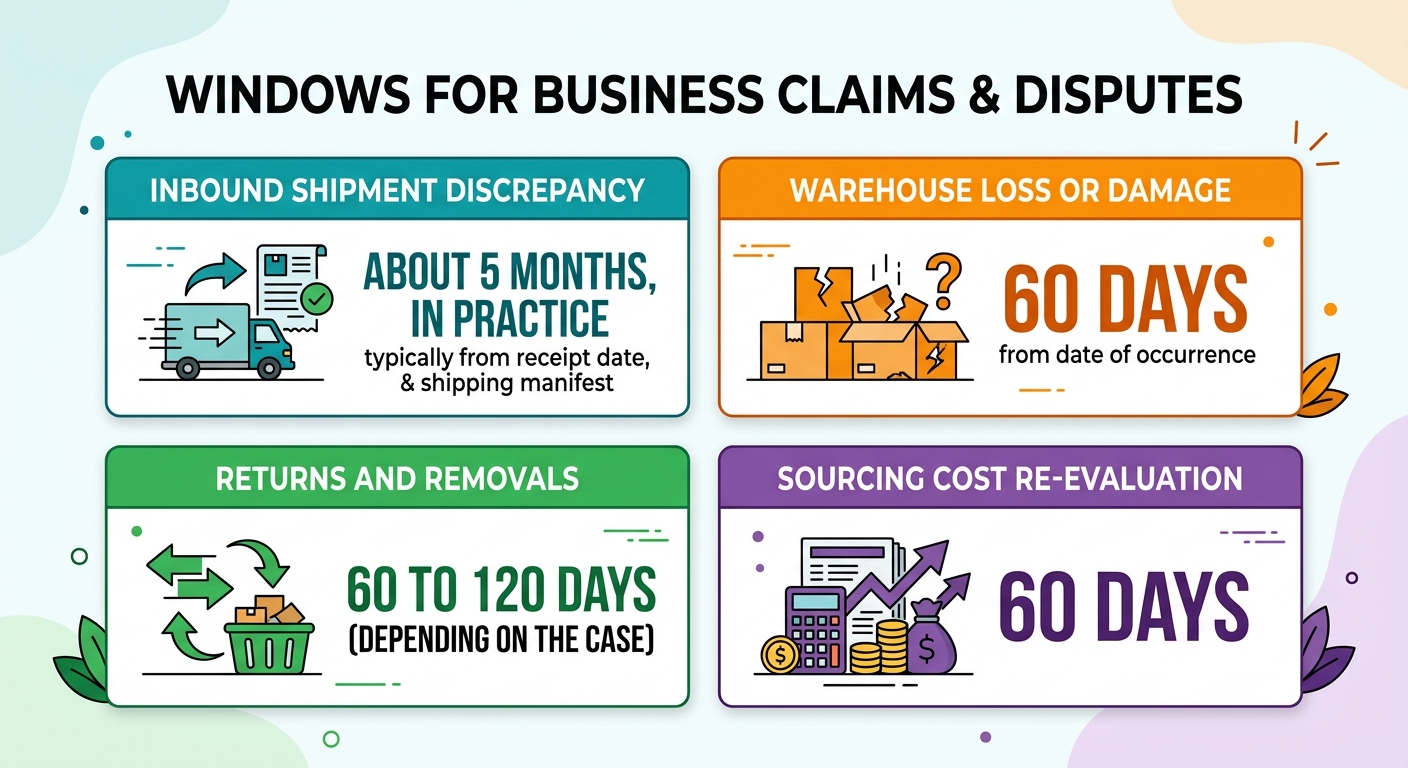
- Warehouse losses: raise them within 60 days of Amazon reporting them.
- Customer returns: a window opens between 60 and 120 days after the refund.
- Holiday purchases: returnable until January 31.
That last one is the trap. Black Friday and Christmas claims keep opening and closing well into spring.
I listed every window in Amazon Q4 2026 Deadline Checklist for FBA Sellers.
By January, there is finally time to look. The oldest of those windows are already closing, while you discuss new year strategies and contract renewals.
The agencies that set up a trusted partner before peak are the ones whose clients stay covered through it. FBA issues don't backfire on them.
If you manage FBA accounts and want to see how this would work on one of your clients:
👉 Book a call or write us a mail
I'll show you what the group looks like and how we'd split the work with you.