Amazon Q4 2026 Deadline Checklist for FBA Sellers
13 weeks, 7 deadlines and 4 claim windows. This is how the FBA game unfolds in Q4 2026.
Go through the list below and count how many you were actually ready for.
If it's fewer than 11, take action now.
📅 Which Amazon FBA Deadlines Actually Matter in Q4 2026?
Seven dates carry real weight for EU sellers between now and January 31, and every one of them sits on the calendar for a specific, practical reason. Two smaller cutoffs already passed this month without most sellers noticing, and four are not shipping deadlines at all but get treated like one because of when they land.
Already behind you: the inbound cutoff for Prime Big Deal Days closed on September 9 for most of the EU and September 16 for the UK.
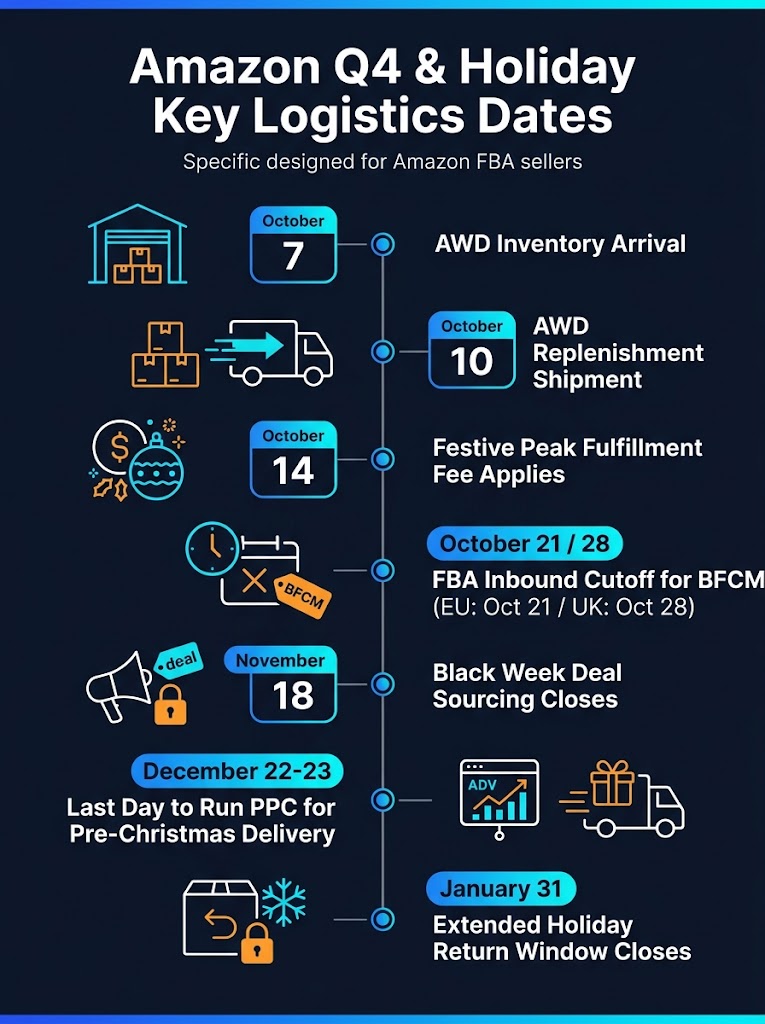
Still ahead of you:
- AWD inventory arrival: October 7
- AWD replenishment shipment: October 10
- FBA inbound cutoff for Black Friday and Cyber Monday: October 21 (EU) / October 28 (UK)
- Festive peak fulfillment fee applies: October 14 (last day before it starts)
- Black Week Deal sourcing closes: November 18
- Last day to run PPC for guaranteed pre-Christmas delivery: December 22-23
- Extended holiday return window closes: January 31
1. AWD inventory must arrive at AWD distribution centers: October 7
Only applies if you use Amazon Warehousing and Distribution to stock up ahead of Black Friday. AWD is widespread in the US, but it has only recently arrived in the EU and UK, and for a reason: AWD Europe Was Not Built for European Sellers.
2. AWD replenishment shipment to FBA must be created: October 10
The follow-up step after #1. Miss it and AWD inventory is not flowing into FBA in time. This applies if you don't have automatic FBA replenishment active.
3. FBA inbound cutoff for Black Friday and Cyber Monday: October 21 (EU) / October 28 (UK)
The one deadline that applies to almost every EU seller. This is also, in practice, your Christmas readiness deadline: Amazon has not published a separate Christmas inbound cutoff, because fulfillment centers shift priority straight from receiving inventory to processing customer orders once Black Friday stock is in, with inbound delivery slots getting tighter through November and December.
4. Last day before the festive peak fulfillment fee applies (UK and Germany): October 14
Not a shipping deadline. From October 15 through January 14, 2027, an average of £0.12 per parcel and £0.07 per large/extra-large envelope applies in the UK, and €0.27 per unit in Germany, for the shipment types it covers. Nothing to ship by this date, just a cost that starts applying to normal FBA activity from the next day, and one you should factor into your margin calculations.
5. Deal sourcing closes for Black Friday and Cyber Monday Lightning Deals and Best Deals: November 18
The last day to submit these specific deal types for the event. Standard price discounts can still be submitted after Prime Big Deal Days ends.
6. Last day to run PPC for guaranteed pre-Christmas delivery: December 22-23
Amazon publishes this as a customer delivery cutoff, but it is a seller deadline too. December 22-23 is the last window for Prime delivery across EU and UK, the final point at which a customer can order and still receive an item before Christmas. Past that date, every euro of PPC spend still bidding for "in time for Christmas" conversions will not work. You don't need to shut off your PPC campaigns completely, but you do need to tune them accordingly.
7. Extended holiday return window closes: January 31
Purchases made between November 1 and December 31 can still be returned by the customer up to January 31, under Amazon's extended holiday return policy. Until that date passes, your margin for the whole Black Friday through Christmas season is not final. Every day a customer can still send something back is a day your real net revenue for the quarter is still moving. January 31 is the day returns for the season stop landing and you can finally close the consolidated margin calculation for the whole holiday period. I wrote about how this exact window quietly erodes FBA margins in an earlier piece on the Amazon holiday return trap.
⏳ What Are FBA Reimbursement Claim Windows, and Why Do They Matter Right Now?
A reimbursement claim window is not a deadline to finish getting your money back. It is the deadline to raise the issue with Amazon for the first time. Miss it, and you lose the right to open that claim, even if Amazon was clearly wrong. Flag it before the window closes, though, and the resolution itself can keep running well past that date. Amazon closes the door on new claims, not on ones already in motion.
This is the part of Q4 that is easy to lose track of, because none of these windows announce themselves. There is no countdown banner in Seller Central. They simply expire. If you want the full map of what you can claim in the first place, I covered every reimbursement type in Every FBA Reimbursement You Can Claim in 2026.
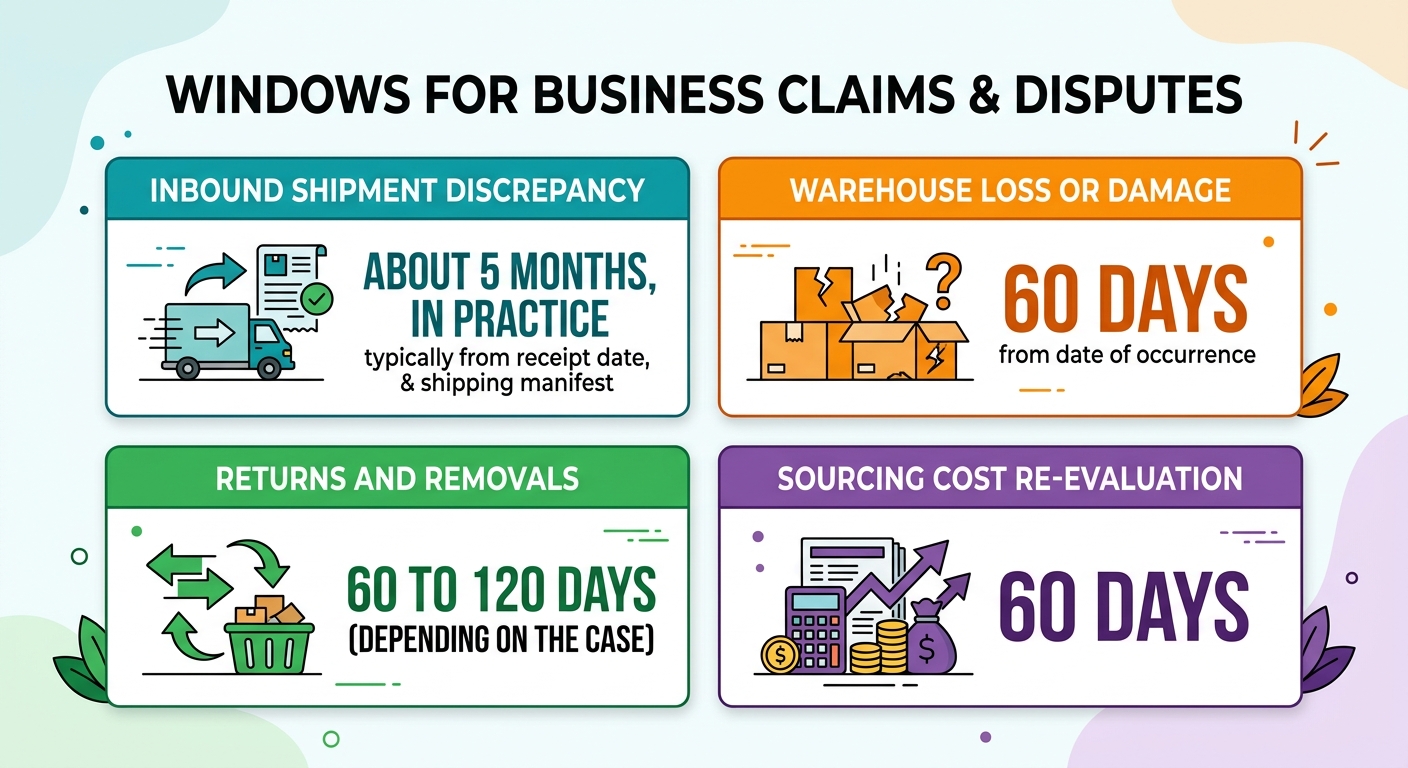
- Inbound shipment discrepancy: about 5 months, in practice
- Warehouse loss or damage: 60 days
- Returns and removals: 60 to 120 days, depending on the case
- Sourcing cost re-evaluation: 60 days
1. Inbound shipment discrepancy
What it covers: units you shipped to Amazon that were never received, or were received in the wrong quantity.
Window: on paper, 6 months from the day Amazon first receives the shipment. In practice, closer to 5. Receiving takes around 3 weeks to close, and you can only open a case once it has. The clock starts on day one, but you can only act from week three or four.
2. Warehouse loss or damage
What it covers: inventory lost or damaged while stored at, or moved between, Amazon fulfillment centers.
Window: 60 days from the day Amazon reports the unit as lost or damaged.
Since late 2024 Amazon reimburses 50% of these automatically, and many sellers take that to mean they no longer need to check. Automatic does not mean complete, and it does not mean correctly valued (I explained why the valuation often comes in low in Your FBA Reimbursements Are Low. Here's Why.).
Transfers between Amazon warehouses deserve special attention: units go missing in transit between fulfillment centers, and these are the losses that are hardest to spot and are definitely not automatically reimbursed. More stock moving around the network in Q4 means more chances for it to happen.
3. Returns and removals
What it covers: everything that goes wrong after the item leaves the shelf. Customer returns that never come back, come back damaged, or come back as something else entirely (return fraud), and removal orders lost or damaged on their way back to you.
Window: it depends on the case.
- Customer returns: between 60 and 120 days after the customer's refund. You cannot file before day 60, because Amazon first gives the customer time to send the item back.
- Removal lost in transit: between 15 and 75 days after the removal shipment was created.
- Removal delivered damaged, incomplete, or with the wrong items: 60 days from delivery.
This is the category the holiday season hits hardest. With the extended return window running until January 31 (deadline #7 above), claims on Black Friday and Christmas returns start opening in January and keep closing until around May.
4. Sourcing cost re-evaluation
What it covers: reimbursements Amazon already paid you, but valued too low. Once your sourcing cost is approved, you can ask Amazon to recalculate past reimbursements at the right value.
Window: 60 days from the date the original reimbursement was issued. Not from the day your sourcing cost gets approved.
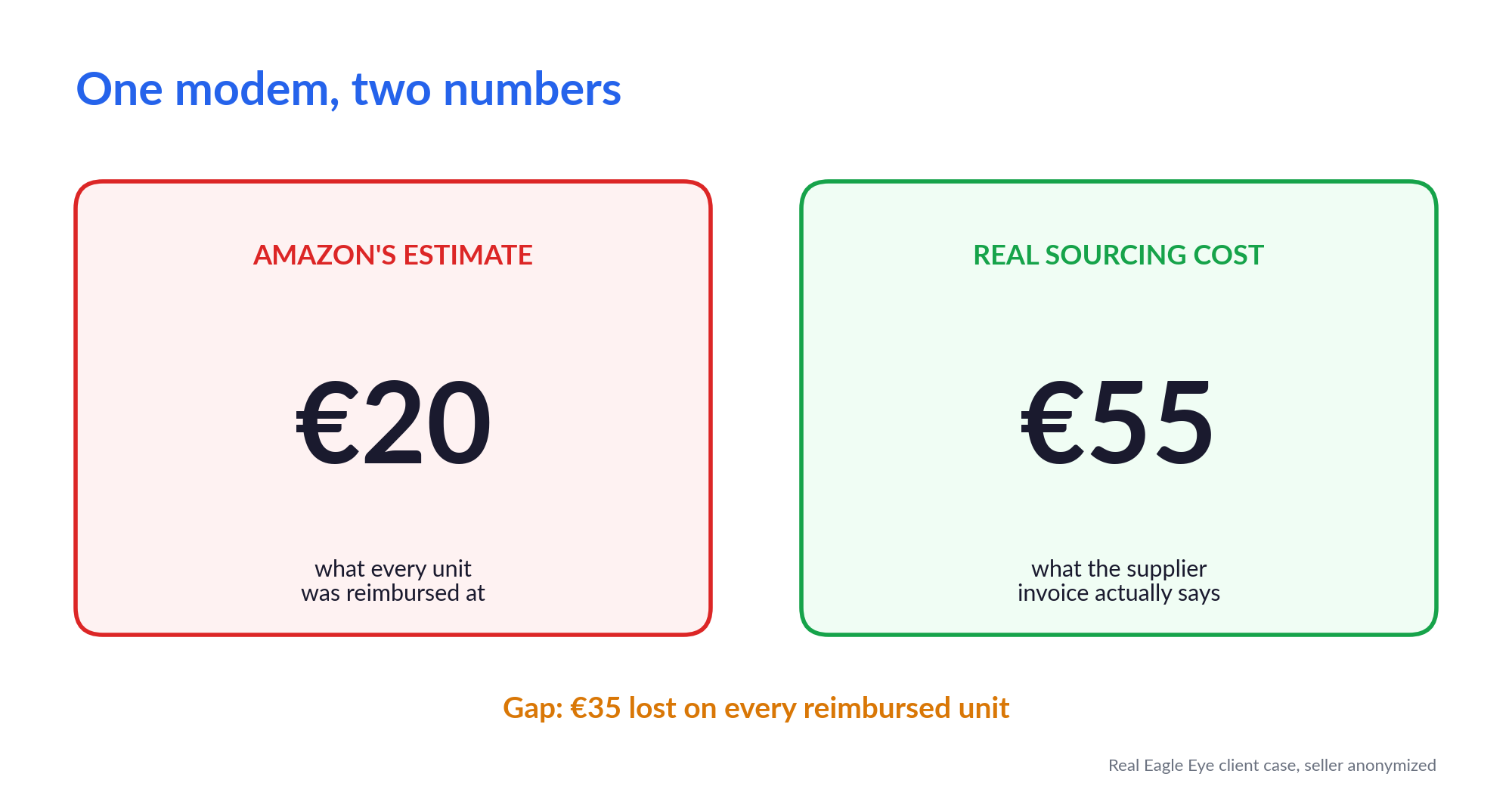
That second detail is the trap. Each reimbursement carries its own 60-day clock, and every day spent getting a sourcing cost approved is a day the oldest ones slide out of reach. Amazon will not re-evaluate anything on its own: if nobody asks, the low valuation stays. I walked through a real case in Two Rejections Later, One Sourcing Cost Update Was Worth €805. More Q4 volume means more reimbursements to re-evaluate, with the same 60 days to do it.
Have you checked when any of these windows close for issues already sitting in your account? Most sellers only find out a window existed after it has already shut.
⏰ What Should You Do Before These Windows Close?
Tracking seven shipping deadlines and four open claim windows, at the same time as running actual Q4 sales, ads and stockouts, is exactly the kind of thing that falls through the cracks. Not because sellers are careless, but because attention is a finite resource and Q4 spends all of it elsewhere.
"You may delay, but time will not." – Benjamin Franklin
None of this is easy to control now that Q4 is starting. Deadlines and claim windows do not send reminders, and by the time you notice one has closed, it is usually too late to do anything about it. This is exactly what Eagle Eye handles in the background, permanently, so claim windows stay tracked without taking your attention away from actual selling. Take a look at what we do.