AWD Europe: Why 68% of EU Sellers Cannot Use It
Amazon Warehousing and Distribution went live in Europe on 20 August 2026. Germany, France, Italy, Spain, and the United Kingdom.
In the United States it has been running for four years. Four years is a long time to watch a program work somewhere else.
I had started to assume it would never cross over. Customs. Member states with their own rules. And the United Kingdom sitting outside the EU. It was easy to believe Amazon had quietly filed Europe under "not worth the complexity."
So the arrival is good news, and it confirms how seriously Amazon takes the EU region.
But here is what became obvious the moment I read the requirements. Amazon did not bring AWD to Europe. Amazon built a different product and gave it the same name.
That is not a complaint. Given the constraints, it is the only thing they could have done.
🚪 The Number Everyone Is Publishing, and the One That Matters
This week the coverage is all about the rates. In the EU, 11.09 euro per cubic metre per month. In the UK, 0.32 pound per cubic foot per month. Flat rate. Those numbers are real, and they are competitive.
But the rate is not what matters at this stage. Here is what you should be paying attention to:
"In the European Union, AWD is available for products enrolled in the Pan-European FBA program. Products listed in a single marketplace only are not eligible at this time. EU AWD requires Germany VAT registration plus one additional country (France, Italy, Poland, or Spain)."
Read the second half again. Germany is not one option among several. Germany is the only option, and everything else is the plus one.
What that looks like inside real accounts
We ran the numbers across 109 accounts we manage.
Only 35 of them, 32%, sell actively in Germany alongside at least one other Pan-EU country. Those are the AWD ready ones. No Germany, no AWD, no matter how well the rest of the operation runs.
The figure that stopped me was a different one. 67 of those 109 accounts have no active Pan-EU marketplace at all. Not one registration short. Not almost there. Nowhere near the door.
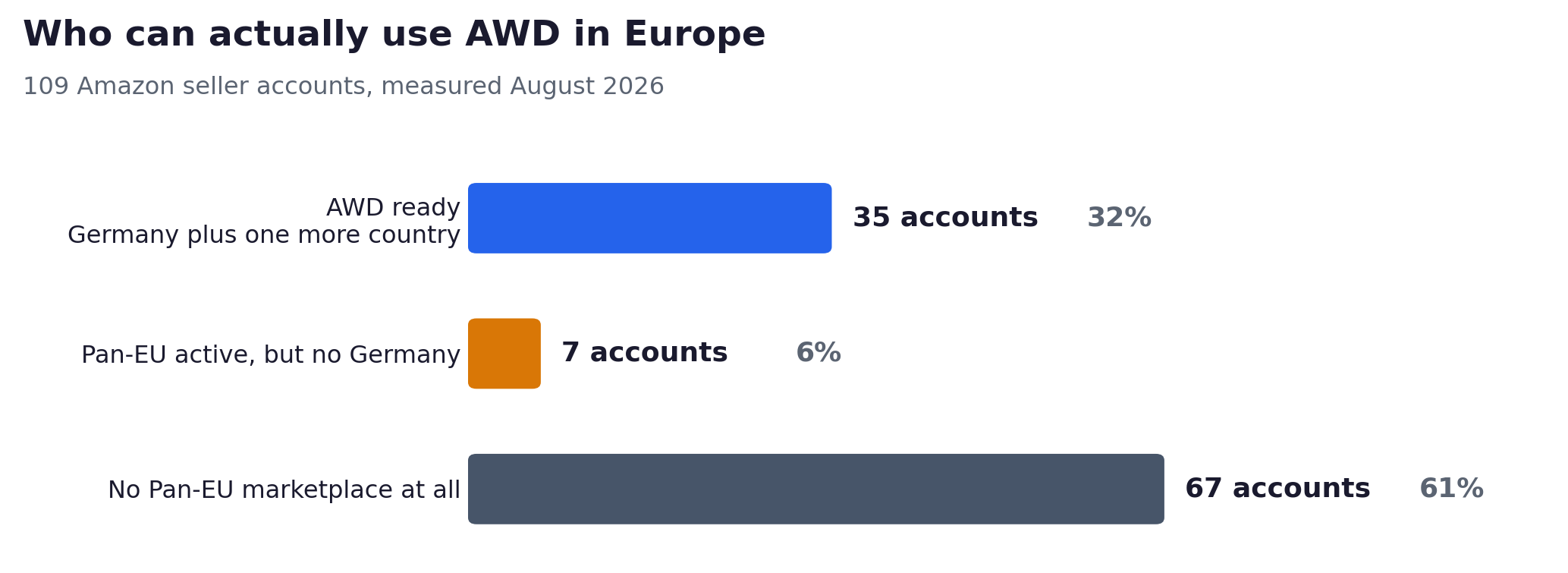
A note on how that was built, because the number is only worth something if you can see the method. We measured active Pan-EU marketplace presence and used it as a proxy for tax registration. Poland was not in the extraction and Poland is a valid plus one, so the eligible share could be marginally higher. And our client base skews Italian, so this is a picture of the sellers we work with, not of the European market as a whole.
So for the majority of European sellers, the real price of AWD is not 11.09 euro per cubic metre. It is opening a German fiscal position and committing to Pan-EU.
🗣️ The Sellers Who Can Use It, and Will Not
Eligibility is only the first question, and for a third of sellers it is the easy one. If you run Pan-EU with a German registration, the door is open. All that is left to weigh is whether the service fits how you actually operate.
That turns out to be a much narrower question than it sounds.
"The map is not the territory." - Alfred Korzybski
In July I was in a conversation with a group of sellers who sit exactly there. Established. Pan-EU. Comfortably through the gate. Not one of them was asking whether they could use AWD. They were explaining why they would NOT.
One of them had already tried it in the United States:
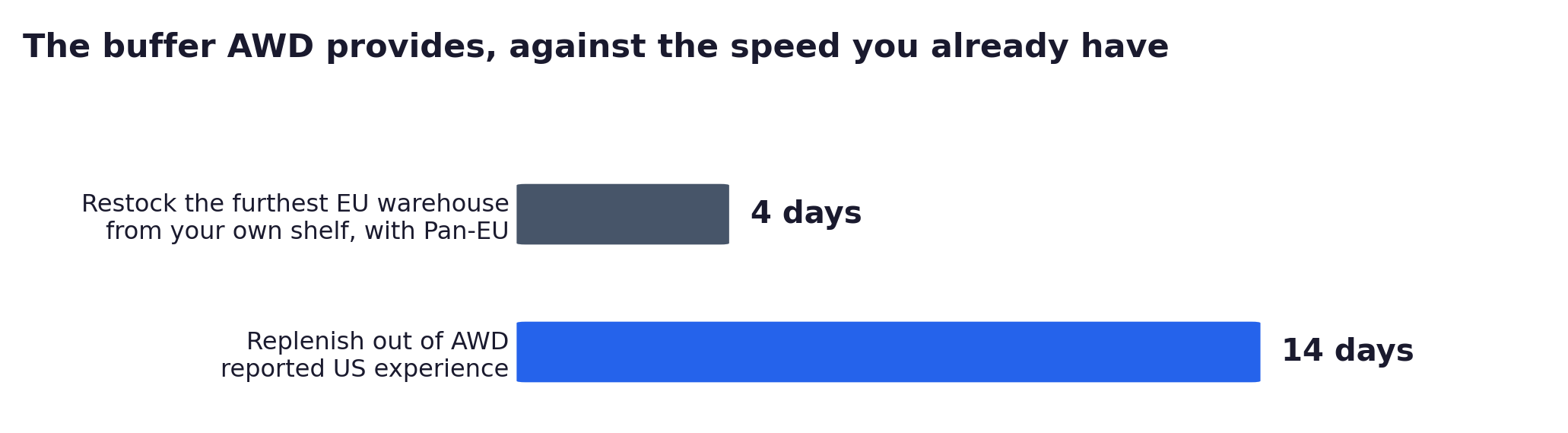
"It looks convenient and the prices are definitely competitive. The problem is I tried it in the US, and the lead times are long. From placing the replenishment order to the goods actually shipping, two WEEKS would pass. I am used to preparing and shipping in two DAYS."
Two weeks against two days. For a seller who has built an operation around responsiveness, it is a downgrade.
Then a second seller said the thing I have not been able to stop thinking about:
"AWD in Europe is for non-EU sellers, a bit like AWD in the US is convenient for us, but in reverse. For those of us here in Europe, unless you have particular needs, long holidays, or you are away for long stretches, it does not make much sense. We restock quickly. With Pan-EU you can resupply the furthest warehouse in Europe within four days, and in 80 percent of cases they make you ship to the same warehouses anyway."
Sit with that for a second.
AWD solves a distance problem. It puts a buffer of inventory close to the fulfilment network so replenishment is fast and storage is cheap.
The buffer solves a problem many European sellers do not have.
And notice who does have it. A seller in Shenzhen or Ho Chi Minh shipping into Europe has exactly the distance problem AWD was designed for. So does a European seller shipping into the United States, which is why AWD works so well there for people on this side of the ocean.
Two independent proofs, pointing the same way. The gate keeps most European sellers out, and the ones it lets in are telling you the product is aimed somewhere past them.
📦 Where AWD Genuinely Earns Its Place
None of this makes AWD a bad program. It makes it a situational one.
Inventory arriving from outside Europe
This is AWD used as it was designed. Your container lands, the units go into bulk storage at a flat rate, and Amazon meters them into the fulfilment network as demand calls for them. You are not guessing at FBA quantities months ahead from the other side of the world, and you are not paying FBA storage rates on a quarter of inventory that will not sell until November.
Your own warehouse is full and Q4 is coming
This is the pressure valve. Your own warehouse is full, Q4 stock is arriving, and FBA has its own capacity limits. AWD becomes overflow space that is already inside the Amazon network rather than outside it.
⚖️ So Does AWD Win in Europe?
In the United States, AWD became a default part of how serious sellers structure their supply chain. Does that happen here, or do the established realities of European logistics hold the line?
The constraints Amazon had to build around are exactly the reasons to doubt it repeats the American story. But sellers shipping into Europe from outside it now have something they did not have last week, and that is a large and growing group.
If you are weighing AWD for your own operation, message me and tell me which of the two cases above you fall into, or why neither fits. I value your opinion.
One new surface to watch
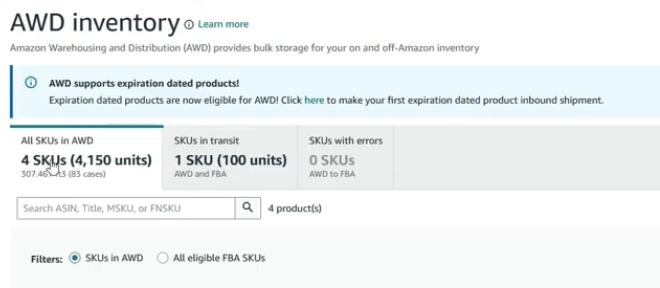
AWD adds a hop. Inventory used to go straight to FBA. Now it goes to AWD, then from AWD to the fulfilment centre. Two reconciliation points become three, and units can go missing or get damaged at either end.
That is not a reason to avoid AWD, deal with it with awareness and remain in control. At Eagle Eye we recover reimbursements on both sides of that new hop, the FBA side you already know and the AWD side you are about to inherit.