Your FBA Reimbursements Are Low. Here's Why.
You get a reimbursement from Amazon. You look at the number. Something is wrong.
The unit costs you €12 to produce. Amazon is giving you €4.
You open a case. Seller Support gives you the same answer every time: this is the correct amount based on our records.
It is not a mistake. It is a policy that went live in March 2025, and if you have not taken action since, you are giving money away on every reimbursement Amazon processes.
📋 What Changed in March 2025
Until early 2025, Amazon calculated reimbursements for lost or damaged FBA inventory based on something close to the estimated sale price of your item. It was never exactly your selling price, but it was generally in the right ballpark for many products.
In December 2024, Amazon announced a major policy shift. Starting March 31, 2025, reimbursements for inventory lost or damaged before a customer order would be based on manufacturing cost, not sale price.
Amazon defines manufacturing cost as:
Your cost to source a product from a manufacturer, wholesaler, reseller, or produce the item if you are the manufacturer. It excludes shipping, handling, customs duties, or other costs.
Source: Amazon Seller Central, Manage Your Sourcing Cost
This already costs sellers money. Moving from estimated sale price to sourcing cost means lower reimbursements for most products. But the real damage happens in a second step, one that Amazon applies by default: when you do not supply your sourcing cost, they estimate it themselves.

🎲 The Number Amazon Uses When You Have Not Told Them
When you have not submitted your actual sourcing cost, Amazon does not leave the field blank. They fill it in themselves, using what they call an estimated manufacturing cost, benchmarked against comparable products sold on the platform.
BUT, their estimate is consistently low. Often far from your real costs!
We pulled the data to confirm. In early 2026, our team analyzed the Manage Your Sourcing Cost portal across 97 seller accounts we manage. Here is what we found:
- 90.78% had an Amazon-generated estimate in place. Bad.
- 4.15% of SKUs had a sourcing cost submitted directly by the seller. Good.
- 5.06% had nothing set at all — go low and random. Crazy.

Nine out of ten products, across nearly one hundred accounts, sitting there with no cost information. Every time one of those SKUs gets lost or damaged in an FBA warehouse, Amazon fills in a number, and that number is theirs to choose.
Is it possible that 91% of sellers have intentionally decided to let Amazon estimate?
NO. They simply have not acted. The portal launched, had early bugs, still has some of them. Sellers tried it once and gave up, or never realized what was at stake.
💸 What the Gap Actually Looks Like
Let's make this concrete.
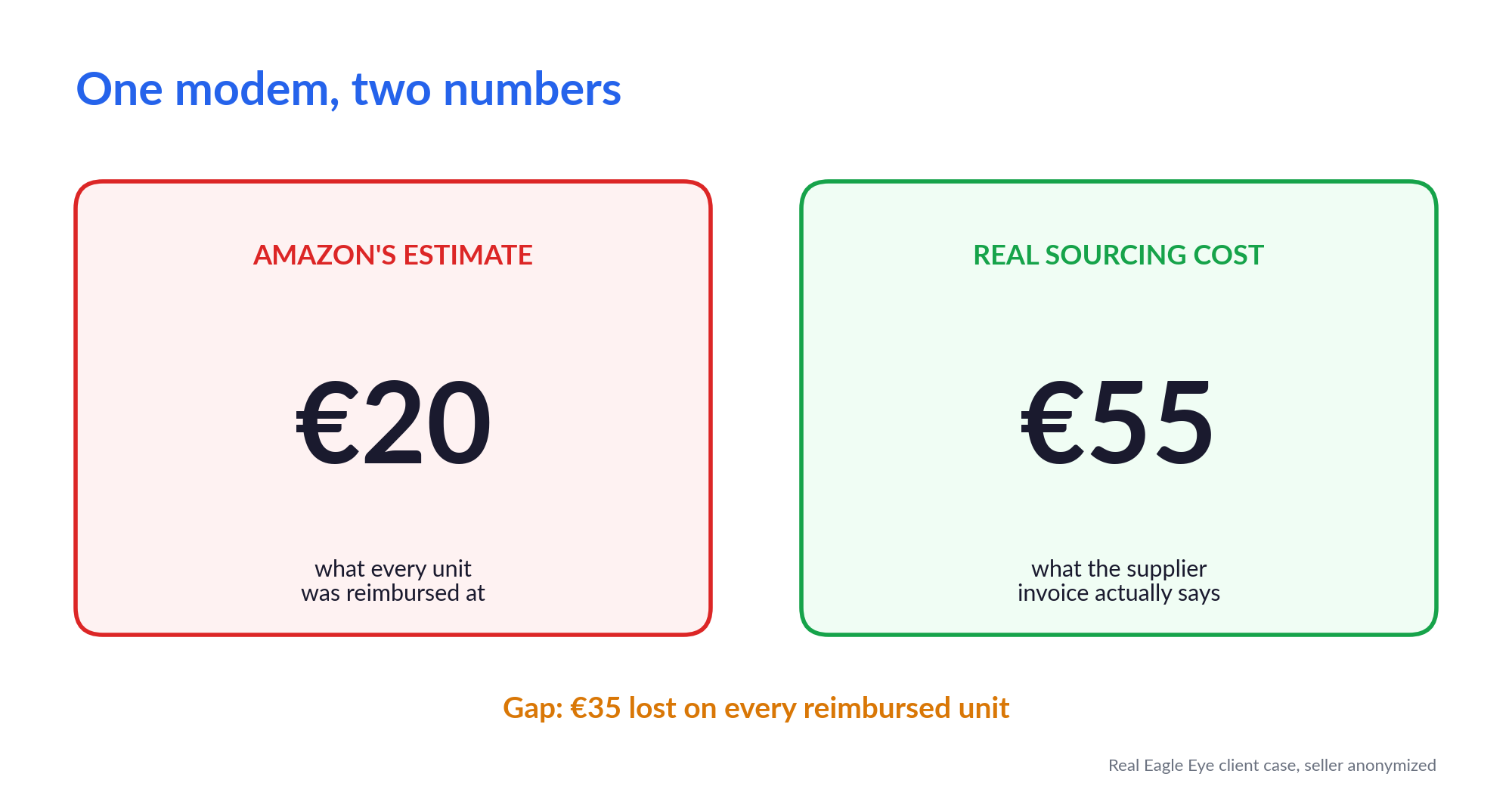
One of our clients manufactures steel products. When a unit gets lost in an Amazon warehouse, they receive a reimbursement of around €4. Their actual production cost is €21. The steel alone costs €13.
Amazon's estimate is not arbitrary. It is benchmarked to comparable items available on the marketplace. But the marketplace has no comparable item at the same production cost, so the algorithm anchors to the lowest available reference. The result is a reimbursement that covers less than 20% of the actual loss. This is unacceptable.

This is not an edge case. It is the natural output of a system where Amazon's estimate has no reason to be accurate and every incentive to be conservative. For a seller with dozens or hundreds of SKUs and a steady volume of FBA losses each year, the cumulative gap between Amazon's estimate and your actual sourcing cost adds up fast.
And unlike most Amazon problems, this one has a direct fix: UPDATE THE SOURCING COST.
🤷 Why Most Sellers Have Not Updated Their Costs
If the fix exists, why are nine out of ten sellers still exposed? There are three reasons.
1. It does not hurt until it does
Updating sourcing costs requires locating invoices or cost documentation for each FNSKU, uploading them to the portal, and waiting for Amazon's review. For a seller with a large catalog, this is a real project.
The problem does not feel urgent. You do not notice until a reimbursement arrives with a number that looks wrong. By then, it is too late.
2. A misplaced concern about supplier data
To submit a sourcing cost, you need to provide a document that names your supplier and shows the unit price. Some sellers hesitate, worried that handing Amazon supplier information could give them visibility into their supply chain.
The concern does not hold up. Sellers who think this way end up protecting supplier names at the cost of systematic under-reimbursement on every future loss. Whether or not the risk is real, the outcome is certain.
3. They tried once, hit problems, and never came back
The Manage Your Sourcing Cost portal launched with a rough user experience. Documents were rejected for unclear reasons. Technical errors were common. Many sellers attempted to update their costs in early 2025, hit a wall, and never returned.
A year later, the portal works better but still requires persistence. The sellers who gave up have not come back.
🏪 It Depends on Your Seller Type
Not every seller faces the same process. How you operate changes how easy or hard this is.
Retailer
You buy finished products and resell them. You have purchase invoices. Submitting sourcing costs is straightforward: upload the invoice, confirm the unit price. This is the simplest case, still you can face rejections and waiting times.
Private Label
You source from a manufacturer or supplier and sell under your own brand. You have supplier invoices. The submission works the same as the retailer case.
Private Label Manufacturer
You produce what you sell. This is where it gets complicated.
Amazon's policy states that manufacturers can submit their cost to produce the item. However, the policy does not specify how production costs should be documented, and Amazon has no standard review process for this case. Submissions are rejected more often, require more back-and-forth, and take longer to resolve, even now, a full year after the policy launched.
If you are a manufacturer, this is a fight worth having, but go in expecting it to take time.
In general, Amazon allows two submission attempts per FNSKU per month. Your starting point is the Inventory Defect and Reimbursement portal, section Sourcing Costs.
⏰ Do Not Wait for the Next Reimbursement
The sellers who get burned on this are the ones who only think about sourcing costs after a reimbursement arrives and looks wrong. By then, it is too late for that specific event.

Start with your top 20 SKUs by volume or unit value. Gather the invoices. Submit them over the next week. Then work through the rest of your catalog at whatever pace is realistic.
There is no retroactive correction. Once Amazon has issued a reimbursement at their estimated value, that amount is final. Updating your sourcing cost will apply to future reimbursements only, not the one that already arrived too low. This is why the moment to act is before the next loss, not after it.
A reimbursement is pure margin. Every euro recovered goes directly to your bottom line. Getting this right is one of the few levers in FBA where the entire upside is yours.
If you need support on getting this right, we are ready to support you.
"Action is the foundational key to all success." – Pablo Picasso