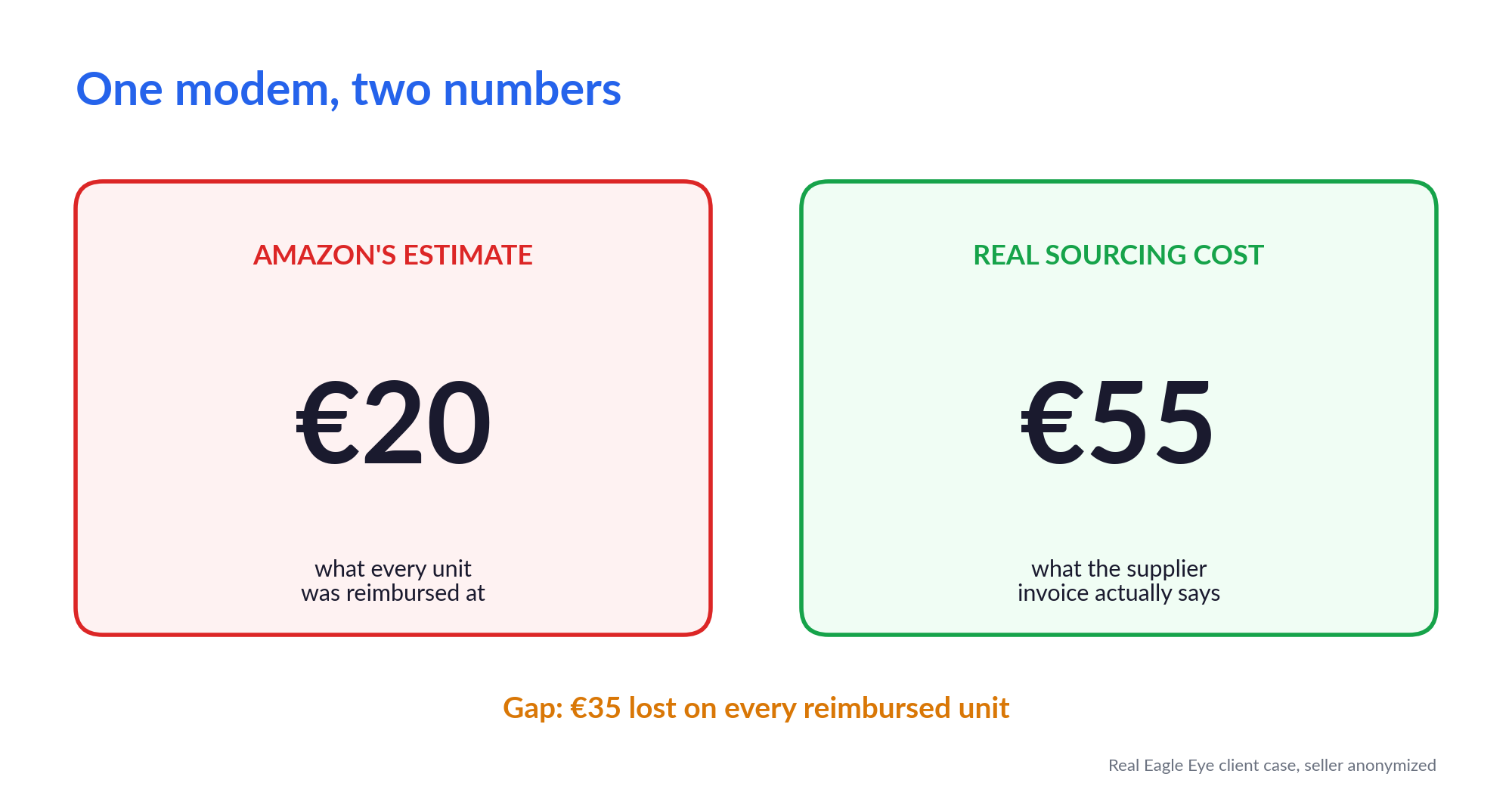

Every FBA Reimbursement You Can Claim in 2026
Instead of an infinite list of reimbursement opportunities, here are the 3 macro zones.
3 Zones of FBA Reimbursements
Most FBA sellers know two or three types of reimbursements, there are more than 10.
Sitting in shipment reports nobody reads, in removal boxes nobody counts, and in return records Amazon processes. Right now, on your account.
This article is a complete map, not a list of claims to file blindly. A framework for understanding WHERE money disappears inside Amazon's system. For each situation you have the legal right to ask and get your money back.
If a man doesn't know which port he sails, no wind is favorable.
Seneca
The framework follows your inventory's journey:
- entry into Amazon
- life inside Amazon
- exit from Amazon
3 zones each with its own process, related problems and corresponding reimbursement opportunities.
Zone 1: Inbound
Chances are you have already experienced this. It is the starting point.
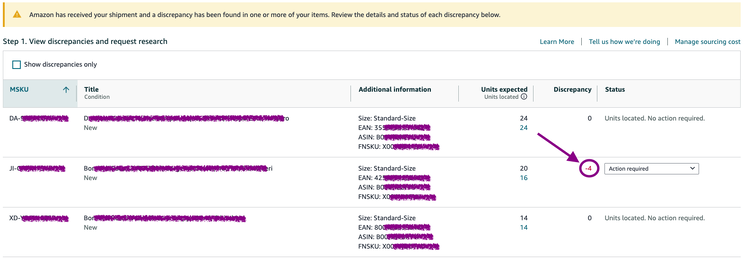
When you send a shipment to Amazon FBA, two things can go wrong.
1.A Ghost Shipments
Your carrier confirms delivery. Amazon says they never received it.
Entire boxes disappear. The courier says delivered. Amazon says nothing arrived.
This does not happen often. But when it does, the financial damage is immediate and significant.
1.B Partial Loading
You send 100 units. Amazon loads 50. The other 50 are not in your inventory, not waiting to be loaded, not anywhere. You sent them. The box was received. But they never made it onto a shelf.
This is a discrepancy between your declared shipment and what Amazon actually processed. A valid claim.
These two scenarios are the tip of the iceberg of FBA issues.
Zone 2: Inside the Warehouse
Once your inventory is inside Amazon's network, you lose control and visibility.
Amazon stores it, moves it, handles it. And sometimes damages or loses it.
When that happens, they owe you the value.
2.A Lost Inventory
Units Amazon simply cannot locate during their internal quantity checks. Not sold. Not damaged. Not returned. Missing.
This generates an inventory discrepancy, and Amazon is obligated to compensate you.
In March 2025, Amazon announced it would begin automatically reimbursing sellers for lost and damaged inventory. Many sellers heard this and stopped watching their reports.
That was a mistake.
Amazon does reimburse some cases automatically. It does NOT reimburse all of them. The sellers who assume the automation is complete are the ones leaving real money on the table.
2.B Damaged by Amazon
A unit falls during order picking. A forklift clips a pallet.
Amazon handles millions of units every day. Damage happens.
When a unit is damaged by Amazon, your reimbursement right is clear. Amazon caused the damage. Amazon pays.
2.C Unauthorized Destruction
Sometimes Amazon destroys your inventory without proper authorization.
A product containing liquid starts leaking in the warehouse after moving it the wrong way. Amazon disposes of it to avoid contaminating other stock.
Amazon deems the unit as dangerous or fake, due to erroneous automated evaluations. Amazon disposes it without prior warning.
In any case you have the right to be refunded.
2.D The Hidden Risk: transfers between Fulfillment Centers
This is the one most sellers have never thought about.
Amazon does not store your inventory in one location.
To guarantee fast delivery across Europe, it redistributes your stock constantly across its network. A product you shipped to Germany can end up in Poland, France, or Spain without you knowing.
Every transfer is a risk.
Units can disappear during these internal movements. Amazon calls this "in-transit inventory." You call it missing stock.
If the unit never arrives at the destination warehouse, you are entitled to a reimbursement.

Zone 3: The R3 Cycle
R3 stands for Returns, Removals, and Reimbursements.
This is where the majority of unclaimed money sits.
The Most Underestimated Zone
Most sellers focus on inbound shipments. Some monitor warehouse losses.
Almost nobody tracks the R3 cycle properly.
- A customer returns an item. Amazon evaluates it. You never verify the evaluation.
- You request a removal. Amazon ships it. You never count what arrives.
- Amazon processes a reimbursement. You never check if the amount is correct.
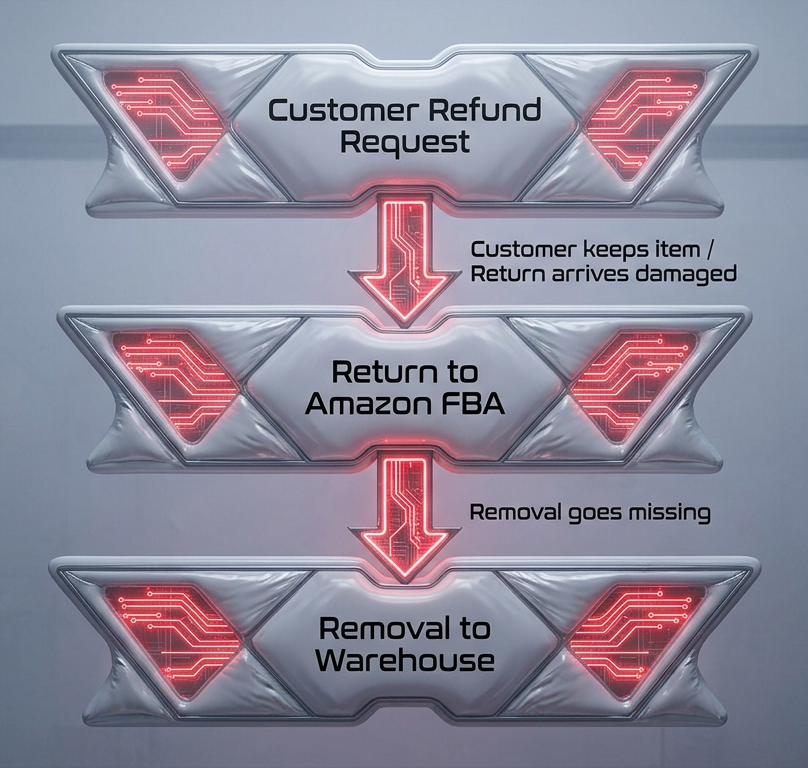
Each step creates a reimbursement opportunity. Let's break them down.
3.A The Customer Was Supposed to Return the item but didn't
A customer requests a refund. Amazon approves it. The customer has 30 days to ship the item back. For electronics, 15 days.
If the customer does not return the item within that window, Amazon owes you a seller reimbursement.
This is not a rare edge case. It happens constantly.
Amazon does not automatically reimburse you for this. You have to claim it.
Most sellers never do.
3.B The Removal That Never Arrives
You request a removal. Amazon confirms shipment. The box never arrives.
The carrier says delivered. You check your warehouse. Nothing.
This is a valid claim. You paid for a removal. Amazon shipped it. You never received it.
3.C The Removal Arrives Short
You request a removal of 100 units. Amazon ships it. You receive 50.
The other 50 are not in the box. Not in a second shipment. Not anywhere.
This is a quantity discrepancy. You are entitled to reimbursement for the missing units.
Most sellers do not count removal boxes. They assume Amazon got it right.
That assumption costs money.
3.D The Switcheroo
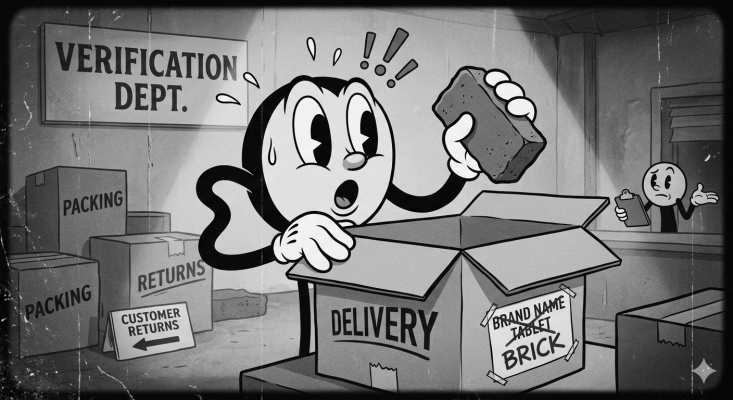
A customer returns an item. But it is not your item.
They bought a high-value product. They returned a cheap knockoff. Or a completely different product. Or a brick.
Amazon evaluates it as "customer return" and charges you the return fee.
Either way, you lost the original unit and got scammed.
This is return fraud. And you have the right to be reimbursed.
3.E Old-for-New
A variation of the switcheroo.
The customer buys your new product. They return their old, used, broken version of the same product.
Amazon evaluates it as unsellable.
Either way, you did not get your original unit back. You got a degraded version.
This is fraud. You are entitled to reimbursement.
3.F The Incomplete Return
A customer buys a product with accessories. A camera with a lens. A laptop with a charger. A set of tools.
They return the main item. They keep the accessories.
Amazon evaluates the return. They do not always check for completeness.
This is a partial return. You are entitled to reimbursement for the missing components.
3.G The European Two-Year Guarantee Scam
This one is specific to Europe.
European consumer law grants a two-year guarantee on most electronic products. If a product breaks within two years, due to a construction issue of the poroduct itself, the customer can request a replacement or refund.
Some customers abuse this.
They buy a product. They use it for 18 months. It breaks (or they claim it broke). They request a refund under the two-year guarantee.
Amazon approves the refund. The customer used it for free. You lose the money.
Most sellers do not track this. They assume Amazon handles it.
Amazon does not.
How Much Is This Worth?
Let me show you two real examples.
Example 1: A seller with €500K annual revenue. R3 audit revealed €18,000 in unclaimed reimbursements.
Example 2: A seller with €2M annual revenue. R3 audit revealed €67,000 in unclaimed reimbursements.
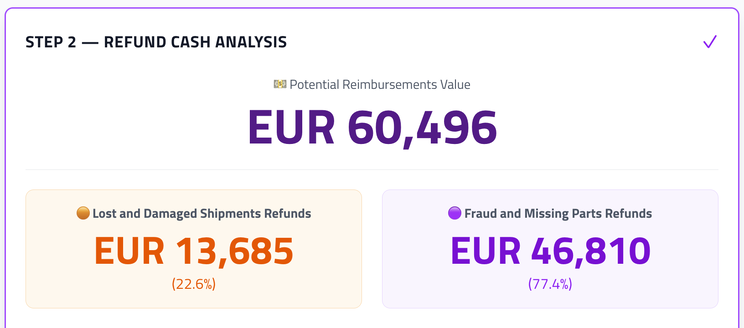
In both cases, the majority of the money was sitting in claims most sellers never think to file.
Ask yourself: when did you last audit all three zones?
Most sellers audit zero. Some audit one — usually inbound shipments, because they are most visible. Zone 2 and Zone 3 go completely unmonitored.
That is where the money is.
The Hard Way
You can track this manually. You will need:
- FBA Customer Returns report
- FBA Inventory Adjustments report
- Removal Order Detail report
- Removal Shipment Detail report
- Reimbursements report
- Manual cross-referencing across all of them
With a complex combination of spreadsheet formulas, you can piece together partial results. It is time-consuming. It is error-prone. And it still misses some claim types entirely.
You still have to fight with Amazon support to get the reimbursements you are entitled for.
The Smart Way
We built a focused audit that answers one question:
"What is my R3 cycle worth, and what reimbursements am I entitled to right now?"
It covers returns, removals, fraud cases, missing parts, and every claim type described in this article. No spreadsheets. No manual cross-referencing. No guessing.
See your numbers in 2 minutes:
👉 Run your free R3 Reimbursement Audit