
Kariba Warehouses in FBA: Reserved Inventory Explained
Gandolfo had 50 units of a high-ticket product inbound to Amazon.
The units were received. They showed up in his Seller Central inventory. And then they stopped.
Not unfulfillable. Not lost. Just "reserved." For weeks.
His listing was live, but those 50 units were not available to sell. At the price point he was working with, every week of blocked inventory was real money left on the table. He waited. He checked Seller Central. He waited more. Nothing moved.
After a month of this, he asked us to take a look.
What we found was a Kariba warehouse. A facility type Amazon does not document for sellers, that does not appear in any notification, and that can silently hold your inventory for months. What Gandolfo's situation taught us about the FBA network is worth sharing, because it can happen to any seller at any time, with zero warning.
"In God we trust. All others must bring data." W. Edwards Deming
📦 What "Reserved" Inventory Actually Means
"Reserved" in Seller Central means Amazon has your units in its network but is not making them available for customer orders.
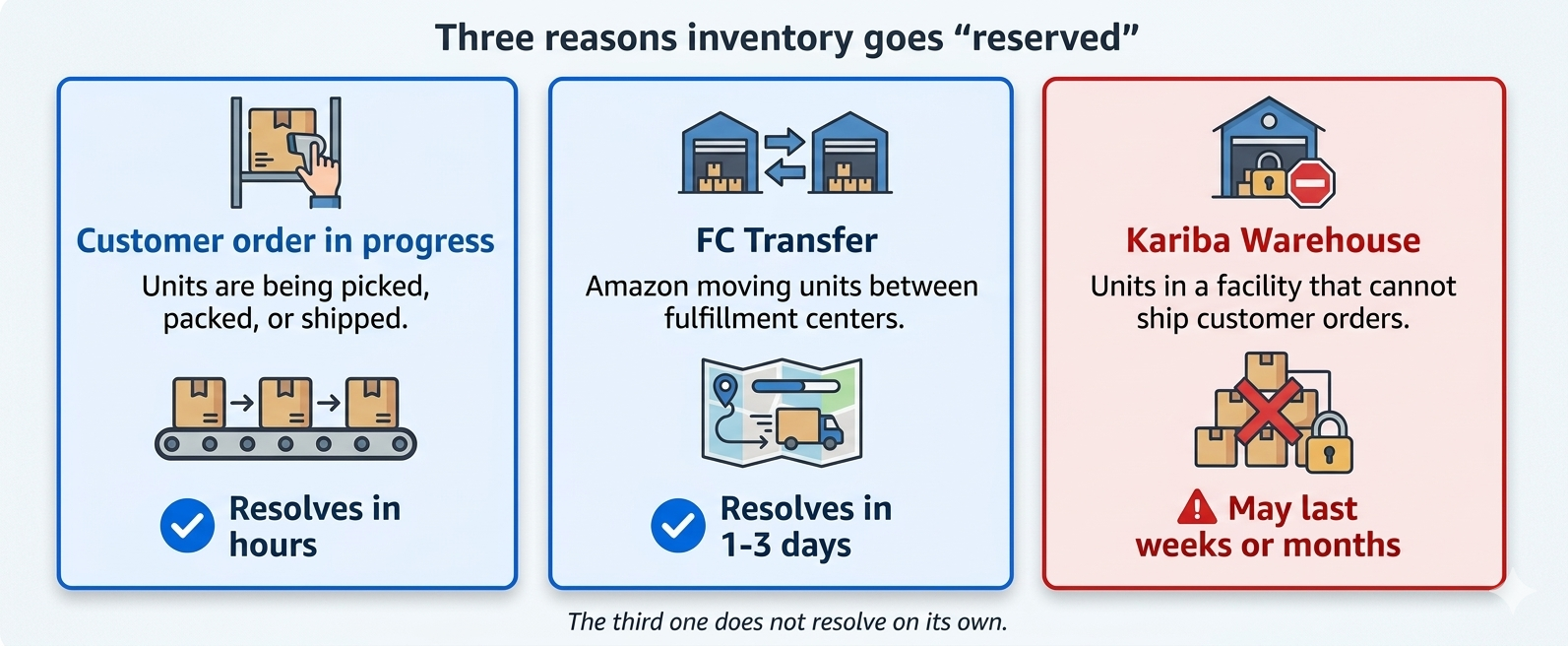
Three things can put inventory into reserved status:
- A customer has placed an order and the unit is in the pick-pack-ship process
- Amazon is transferring units between fulfillment centers as part of its internal rebalancing
- The units are sitting in a facility that is not connected to the customer order flow at all
The first two resolve on their own in hours or days. The third is the one nobody tells you about.
🏭 What Is a Kariba Warehouse?
A Kariba warehouse is an Amazon facility that stores inventory but cannot ship customer orders.
It is not a fulfillment center. Fulfillment centers are where Amazon picks, packs, and ships. Kariba warehouses receive inventory, hold it, and release it downstream into fulfillment centers when capacity opens up. Your units are in Amazon's system, but they are behind a wall that customers cannot reach.
The naming is worth a pause. Lake Kariba is the world's largest artificial lake by volume. In the Tonga language, the word "Kariva" means trap or obstacle. Whoever named Amazon's internal logistics project after it either had a sense of humor or an unusually honest relationship with what these facilities actually do to seller inventory.
In the US, these facilities carry the prefix KRB. A few confirmed examples:
- KRB1 in San Bernardino, CA, in the Inland Empire cluster near the Port of Los Angeles
- KRB3 in Phoenix, AZ, co-located with an Inbound Cross-Dock facility on the same campus
- KRB6 in Aurora, IL, serving the Chicago and Midwest hub
In Europe, the equivalent facilities appear to use the prefix KAR. KAR3, for example, is an active Kariba facility in Italy, confirmed via Seller Central data. European Kariba nodes are far less documented publicly than their US counterparts, but they exist and they behave the same way.

🔄 Why Does Inventory End Up in Kariba?
Fulfillment centers are built to be lean. Amazon runs them as just-in-time environments where inventory moves in and out quickly. Storing large volumes of slow-moving or overflow stock in an FC is expensive. It occupies space that highly automated systems need to stay productive.
Kariba warehouses exist as a pressure valve. When Amazon's fulfillment centers in a region are running near capacity, incoming inventory doesn't get rejected. Instead, it routes to a Kariba facility and waits. The Kariba absorbs the overflow so FCs can stay efficient. When FC capacity opens up, the units transfer out and become available.
Under normal conditions this happens invisibly. The units spend a short time in the Kariba, transfer to an FC, and your inventory is live before you notice the "reserved" status at all. But when regional FC capacity is constrained for an extended period, inventory can sit in a Kariba for weeks.
That is what happened to Gandolfo.
⏱️ Month 1: Gandolfo's Units Don't Move
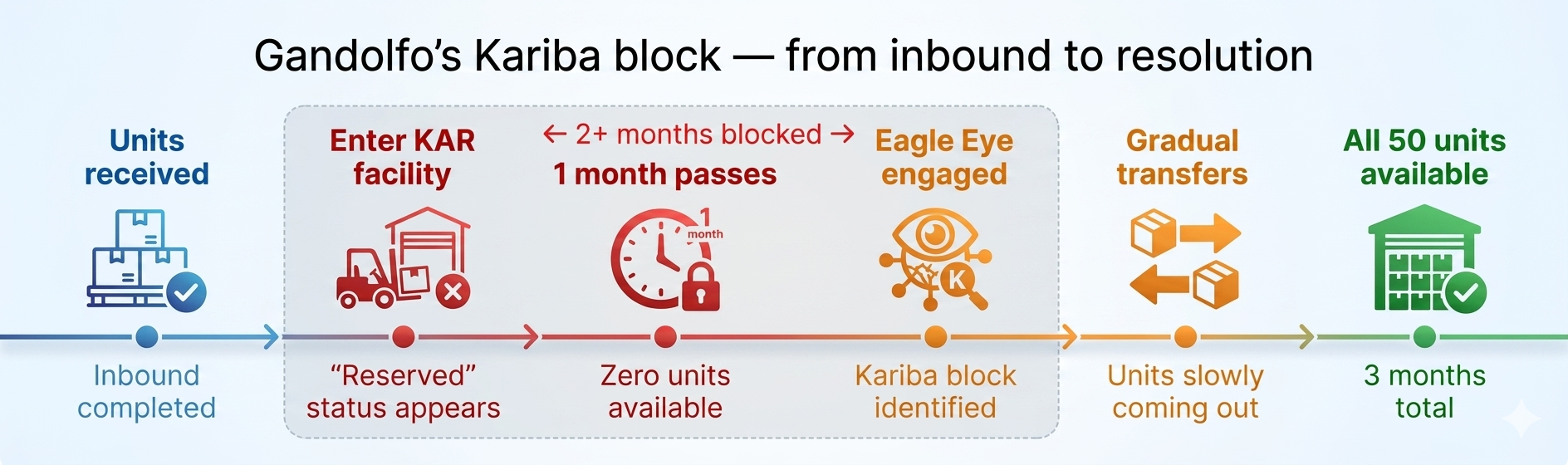
After his units were received into Amazon's network, Gandolfo's account showed a warehouse transfer into KAR3. The units went in. Nothing came out.
One week. Two weeks. A full month. His listing was showing 50 fewer available units than he actually had, and those 50 units were sitting in a facility that could not ship them to anyone.
Amazon's "reserved" status gave no additional detail. There was no notification, no support alert, no explanation. The standard Seller Central view tells you that units are reserved; it does not tell you why, or how long that will last, or what you can do about it.
After the first month, Gandolfo reached out to us. We found the pattern: units had transferred into KAR3 and had not moved since.
📞 Months 2 and 3: Getting the Units Out
Knowing the cause does not automatically fix it. The only way to move inventory out of a Kariba warehouse is to push Amazon to do it.
We opened support tickets on Gandolfo's behalf and were specific: we identified the exact ASIN, the quantity, the location code, and the duration of the block, and requested a transfer to an active fulfillment center.
The process required persistent follow-up. Tickets needed to be reopened and escalated. The resolution did not happen in a single contact, and it did not happen overnight.
What it looked like in practice was a gradual unblocking over weeks. By the end of the third month, all 50 units had transferred out.
3 months. 50 high-ticket units. One facility code that does not appear anywhere in Amazon's seller documentation.
🧭 What This Means for Your Business
FBA sells a promise: hand over your inventory to Amazon and stop thinking about logistics.
That promise works 80% of the time. Kariba is proof that it does not work all of the time.
Gandolfo's case was not exceptional. The same pattern can repeat for any seller, at any volume, with no advance warning.
The sellers who protect their businesses are not the ones who micromanage Amazon's operations. They are the ones who know what to look for when something is off. They know what a KAR or KRB code means. They know that "reserved" is not always temporary.
This kind of visibility requires consistent monitoring and the knowledge to read what the data is showing. That is not something most sellers have bandwidth to build in-house.
Eagle Eye helped Gandolfo get his 50 units out of KAR3. If you have reserved inventory that has been sitting longer than you would expect, we can take a look at your account and tell you what is actually happening. Start here.